FemiCore Ratings: Seller Stars vs Our 3.9 Editorial Score
A row of stars and a number out of five look like the same kind of thing. They are not. One is a sales-page graphic nobody can check; the other is a judgement with its working shown.
Contents
- 1Two kinds of FemiCore ratings, and why they differ
- 2The seller’s star line: what is shown and what is not
- 3How our 3.9 editorial score is built
- 4Where the other figure, 3.2, comes from
- 5What a 3.9 out of 5 does and does not mean
- 6How to read star ratings on any supplement
- 7Your own result beats any rating
- 8Our verdict on FemiCore ratings
FemiCore ratings come in two very different forms, and most confusion starts when they are treated as one. The seller’s sales page carries a stars graphic and a large review count. Our site gives FemiCore an editorial score of 3.9 out of 5. This article explains what each one is made of, why only one can be checked, and how to read a star rating on any supplement page without being steered by it.
Two kinds of FemiCore ratings, and why they differ
A rating is only as good as three things behind it: who made it, what it measures and whether you can see the working. Put the two FemiCore figures side by side on those three points and the gap is obvious.
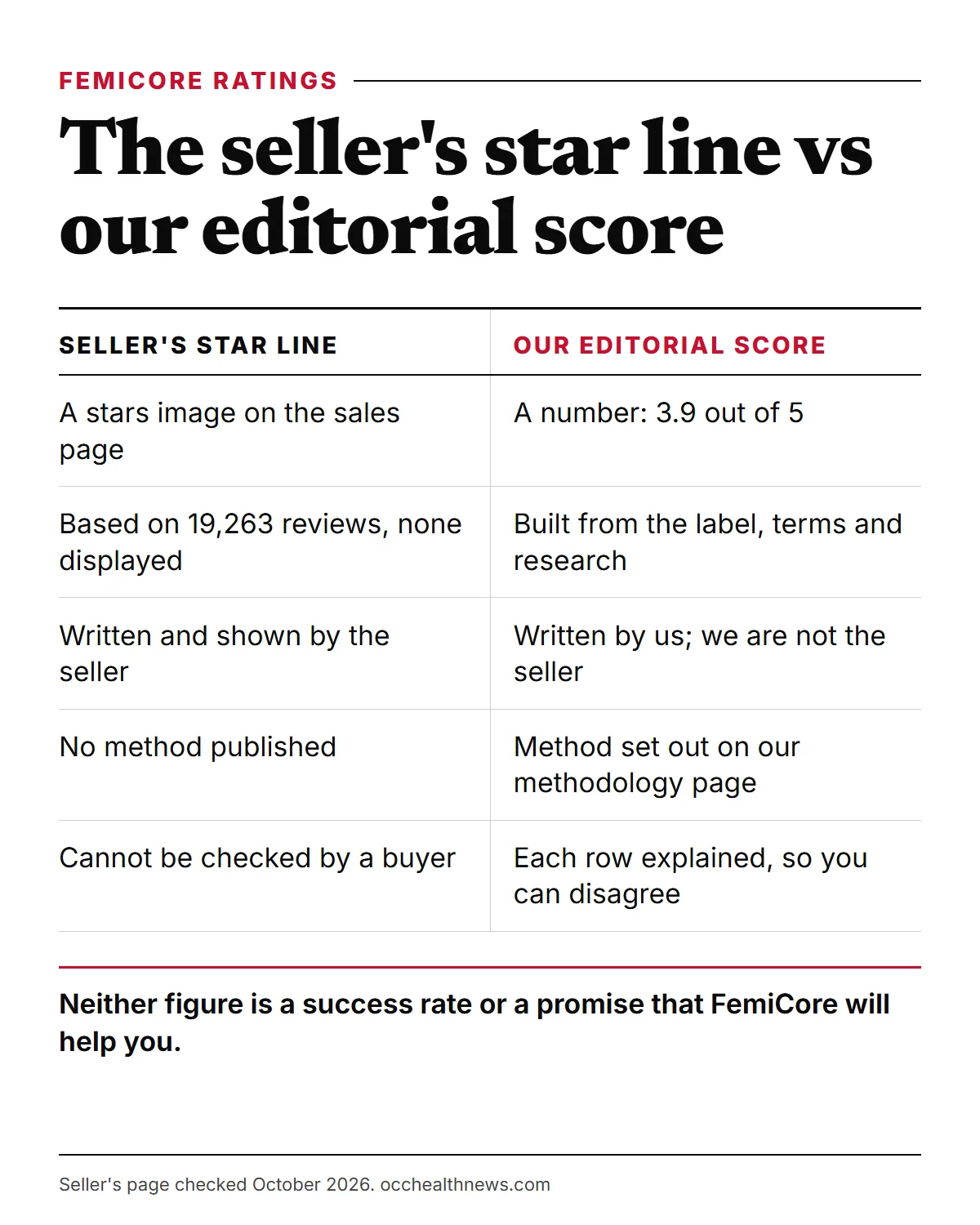
| Question | Seller’s star line | Our editorial score |
|---|---|---|
| Who made it | The seller, on its own sales page | OccHealthNews, an independent publisher |
| What it measures | Not stated | Evidence, transparency, safety, value, refund terms |
| Can you see the working | No reviews are displayed | Each part is explained in our reviews |
| Form | A stars image and a review count | 3.9 out of 5 |
Neither figure is a scientific result. One is marketing; the other is an opinion with its reasons written down. Knowing which is which is most of the job.
The seller’s star line: what is shown and what is not
On the FemiCore sales page the rating appears as a picture of stars next to a line saying customers rate the product, “based on 19,263 reviews”. That is all. When we checked the home page and the order page, there were no individual reviews: no names, no quotes, no photos and no dates.
That matters for a simple reason. A count without the reviews behind it gives you nothing to test. You cannot see how many were low, how recent they are, whether the reviewers bought the product, or what they were asked. A disclaimer elsewhere on the same site warns that testimonials “may not reflect the typical purchaser’s experience”.
None of this proves the number is wrong. It means the number is a seller statement, in the same category as “96% of customers order 6 bottles”, another line on the page that we could not verify. We treat both as claims, not as data.
How our 3.9 editorial score is built
Our score follows the method on our methodology page: every product is judged on the same five questions. For FemiCore, the scorecard in our short review breaks those questions into seven rows.
| Methodology question | FemiCore row | Score out of 5 |
|---|---|---|
| Evidence | Scientific premise | 4 |
| Evidence | Finished product tested | 1 |
| Evidence | Ingredients for the stated use | 2.5 |
| Transparency | Doses disclosed | 1 |
| Safety | Safety profile | 4 |
| Value | Price for what you get | 3 |
| Refund terms | Guarantee and return rules | 4 |
| Overall | Weighted judgement | 3.9 |
The overall figure is weighted, not averaged. We give more weight to safety and to the refund terms because they decide what a careful buyer actually stands to lose: a product that is low risk to take and easy to return costs little to try. That is why a supplement with no trial of its own can still land near 4.
The low rows are the important ones to read. No trial of the finished FemiCore formula has been published, and the nine ingredients sit in a proprietary blend with no individual doses, no probiotic count and no strain codes. The research that does exist is mostly about the ingredients, and some of it, such as the 2023 Cochrane review on cranberry, concerns repeat urinary infections rather than leaks or urgency. The full reasoning is in our FemiCore review.
Where the other figure, 3.2, comes from
Readers who explore our site will also find a FemiCore score of 3.2. It sits in our reviews and ratings breakdown, which uses five criteria (ingredients, value, transparency, guarantee and ease of ordering) and gives each one equal weight. A plain average lets the weak transparency score pull harder, so the result is lower.
The two numbers rest on the same facts. They differ only in the weighting, and they answer slightly different questions: the 3.2 asks how FemiCore does across five equal headings, the 3.9 asks how much a careful buyer risks by trying it. Our headline editorial score, the one shown on our product guide, is 3.9.
What a 3.9 out of 5 does and does not mean
A score is shorthand, and shorthand loses detail. Here is how we would read ours.
It does mean that, on the facts we can check, FemiCore is a reasonable product to try under its refund terms: one capsule a day, no stimulants according to the seller, a written 60-day guarantee from the delivery date, and safety concerns that are known and manageable with a pharmacist’s advice.
It does not mean that FemiCore works, that it helps most people who take it, or that it beats anything else. A score out of five is not a success rate. It also does not mean the product is safe for you in particular; berberine, bearberry and cranberry each carry cautions that depend on your health and medicines.
It could change. A published trial of the finished formula, disclosed doses and a named manufacturer would all raise the evidence and transparency rows. New safety concerns or worse refund terms would lower it.
How to read star ratings on any supplement
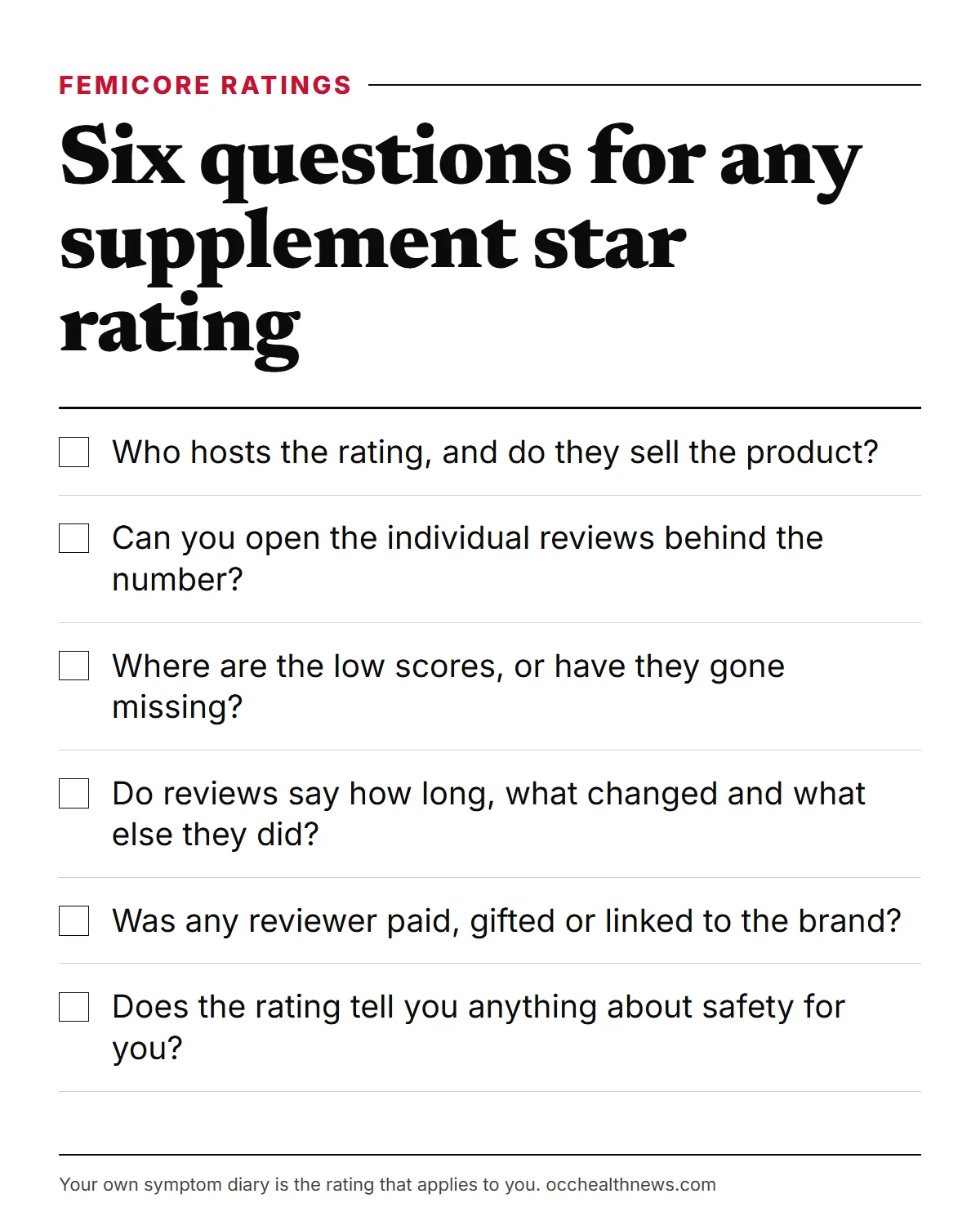
The same habits work whether you are looking at FemiCore or any other capsule sold online. Before a star rating sways you, ask these questions.
- Who hosts it? A rating on the seller’s own page is chosen by the seller. That does not make it false, but it is not a random sample.
- Can you read the reviews? A count with nothing behind it cannot be tested. Real reviews have dates, varied wording and some complaints.
- Where are the low scores? A page with only five-star reviews is curated. Genuine products collect one-star complaints about delivery, taste or cost.
- Do reviews give specifics? Useful ones mention how long the person took it, what changed and what else they did at the same time.
- Was anyone paid or gifted? US rules on endorsements (16 CFR Part 255) require that connections to the brand be disclosed, and the federal rule on consumer reviews (16 CFR Part 465) bans fake reviews, bought reviews and the hiding of negative ones.
- Does it tell you about safety? Almost never. Ratings record satisfaction, not interactions with your medicines.
For bladder supplements there is one more trap. Symptoms such as urgency and night-time trips vary week to week on their own, and expectation alone can make people feel better for a while. A buyer who rates a product in week two may be rating that natural swing. The NIH Office of Dietary Supplements makes a related point: supplement marketing often runs ahead of the evidence, so look for research, not enthusiasm.
Your own result beats any rating
The only rating that applies to your bladder is the one you record. A simple plan fits inside the refund window.
- Before day one: count bathroom trips, strong urges and any leaks for three days.
- During: take one capsule each morning with a big glass of water, as the label directs, and keep other habits steady.
- Around day 50 after delivery: repeat the three-day count and compare.
- Decide before day 60: if nothing has moved, email support with “Refund Request” in the subject and send back every bottle with the packing slip. Return postage is yours to pay.
The seller suggests three months before judging, which is longer than the refund window, so plan the check-in date rather than waiting for a feeling.
Our verdict on FemiCore ratings
The seller’s star line is a sales device: a graphic and a count with no reviews you can open. Our 3.9 out of 5 is an editorial judgement with its parts on display, built mostly on safety and refund terms and held back by missing doses and the absence of any trial of the formula. Use our number to understand the trade-off, not as a promise. The full picture, including price and ingredient tables, is in our FemiCore buyer’s guide and the scorecard page.
Frequently asked questions
What are FemiCore's ratings?
There are two kinds. The seller shows a stars graphic with the line based on 19,263 reviews, which no buyer can verify because the reviews are not displayed. Our own editorial score is 3.9 out of 5, a judgement of the product's evidence, transparency, safety, value and refund terms.
Can the seller's star rating for FemiCore be checked?
Not from the sales page. It shows a stars image and a review count but no names, quotes, dates or individual scores, and its disclaimer says testimonials may not reflect the typical purchaser's experience. Without the reviews themselves there is nothing to check the number against.
Is your 3.9 out of 5 a customer rating?
No. It is an editorial score written by our team from the label, the price list, the refund terms and the published research on the ingredients. We are not the seller, we do not run lab tests, and the score does not predict how FemiCore will work for any one person.
Why do some of your FemiCore pages show 3.2?
One of our articles breaks FemiCore down into five criteria and takes a plain average, which gives 3.2. Our headline score of 3.9 uses the same facts but gives more weight to safety and refund terms, because those decide how much a buyer stands to lose. The two figures answer slightly different questions.
Does a higher star rating mean a supplement works better?
Not reliably. Star ratings mix genuine experience with placebo effects, natural ups and downs in symptoms, and selection by whoever hosts the page. They say more about how buyers felt than about whether an ingredient did anything.
Are FemiCore ratings on Amazon trustworthy?
Treat them with care. The seller says FemiCore is not an authorized Amazon, Walmart or eBay product, so ratings there may describe resold, old or fake bottles, or a different product using a similar name.
How can I rate FemiCore for myself?
Write down bathroom trips, urges and leaks for three days before the first capsule, change nothing else, and repeat the count around day 50 after delivery. If nothing has moved, you still have time to ask for a refund before day 60.
Sources
- 1 Trade regulation rule on the use of consumer reviews and testimonials (16 CFR Part 465) US Code of Federal Regulations
- 2 Guides concerning the use of endorsements and testimonials in advertising (16 CFR Part 255) US Code of Federal Regulations
- 3 Health products compliance guidance US Federal Trade Commission
- 4 Dietary supplements: what you need to know NIH Office of Dietary Supplements
- 5 Cranberries for preventing urinary tract infections Cochrane Database of Systematic Reviews · 2023
About the author
OccHealthNews Editorial Team. We read the studies, guidelines and regulatory filings so you do not have to, and we show our sources on every piece. More about how we work.